The end of vanity metrics in business support

Between 2022 and 2024, the eleven Entrepreneurship Support Organizations (ESOs) now participating in AuRA's Cohort 2 accompanied over 30,000 companies in Colombia. During that same period, 49 investments closed. The conversion rate is 0.1%.
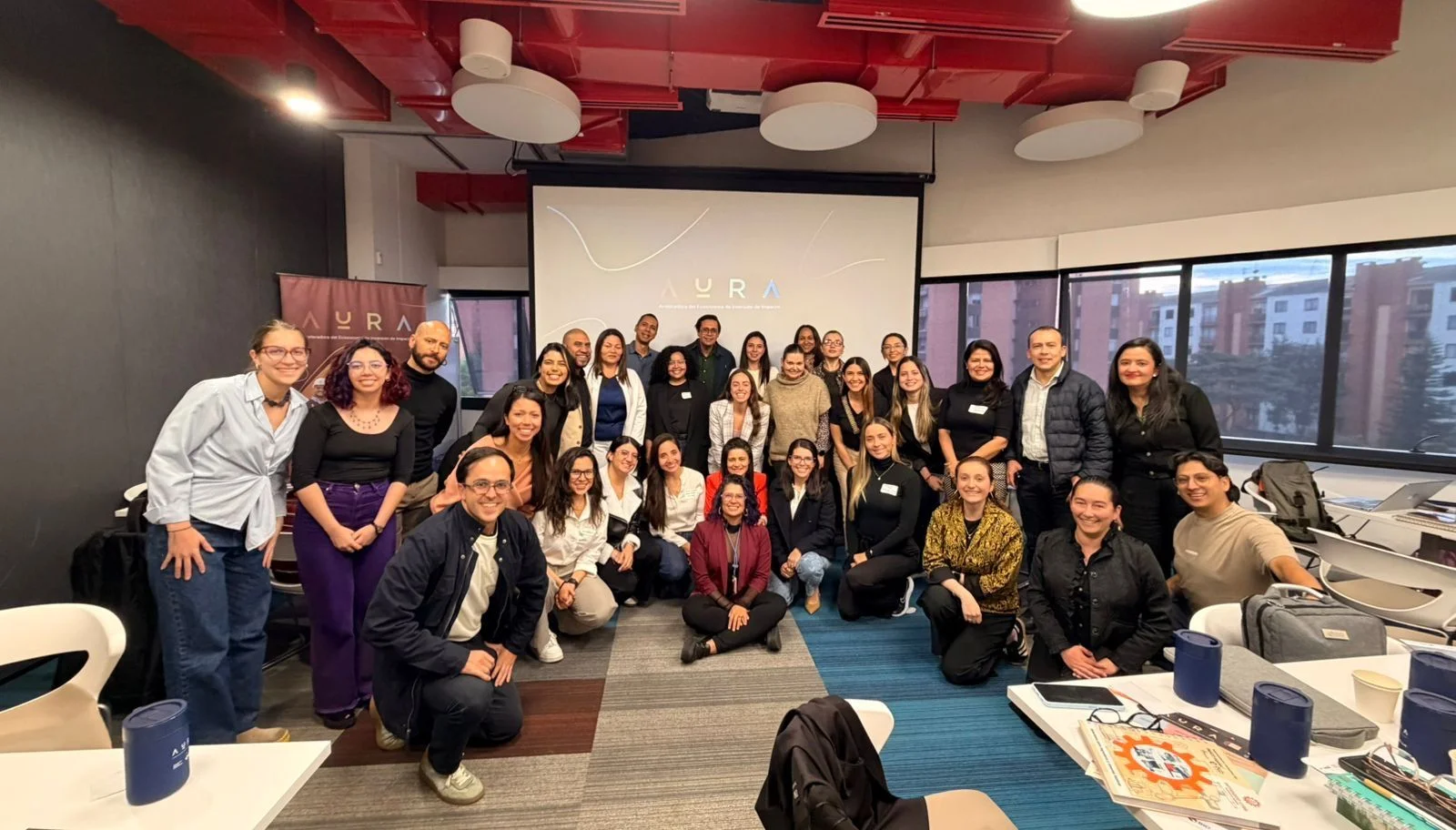
That figure was the starting point for the AuRA bootcamp, the program led by the Bolívar Davivienda Foundation and IDB Lab. It wasn't presented as background context. It was put on the table as a question directed at each of us: what are we actually doing when we say we "support" companies?
The honest answer is uncomfortable. Most business support in the region is still measured in training hours delivered, workshops held, and companies enrolled. These are metrics that report well, fill annual reports, and justify the next funding round. But they are vanity metrics. They don't move capital, don't scale models, and don't change the trajectory of an entrepreneur with real purpose. That's why we joined AuRA: to change how we measure what we do.
The traditional acceleration model has run its course
For a decade, Latin America's ecosystem operated on Silicon Valley logic, adapted halfway: cohorts, demo days, mentoring, certificates. It worked for building community and professionalizing the conversation around entrepreneurship. But it didn't solve the underlying problem — the friction between entrepreneurs with solid models and funds with a mandate to invest in them.
Impact entrepreneurs, in particular, arrive at the table with a structural disadvantage. They have brilliant models but rarely formal data collection systems. They speak of social change in narrative terms. Funds, for their part, have mandates tied to the Sustainable Development Goals and risk-mitigation requirements that demand technical evidence, not anecdotes. There's a language that isn't being translated, and the cost of that translation failure is that 0.1%.
At Suricata Labs we've been watching this mismatch for years. The public narrative of the ecosystem celebrates capital raises, but in practice most companies that receive support end up in limbo: too mature for incubation programs, too early for institutional funds, without the data infrastructure to cross to the other side. Traditional acceleration alone doesn't bridge that transition.
AuRA is a structural response, not another program
AuRA was not designed as a conventional accelerator. It's an alliance that brings together eleven Colombian ESOs with international cooperation and institutional capital, with the explicit goal of raising the technical bar of business support so ESOs speak the same language as global funds.
For us, participating means aligning around four concrete objectives: refining the criteria we use to identify companies with genuine impact DNA, evolving toward technical advisory that responds to the real needs of impact companies, significantly increasing success rates in investment rounds, and applying gender lenses to ensure capital flows equitably.
What sets AuRA apart from other programs is that these objectives aren't aspirational. Each one translates into tools, measurement frameworks, and verifiable commitments that all eleven ESOs adopt in parallel. The goal is to build a shared technical floor so that the ecosystem functions as a system — not as a collection of isolated initiatives competing for the same funding.
The bridge between purpose and capital has three dimensions
When an impact company arrives at Suricata Labs, what it's asking for — even if it can't articulate it that way — is help crossing three simultaneous gaps. Our work within AuRA is to operate all three as a single process.
The first is the business model gap. Impact must be embedded in the operating DNA from day one, not added on as a marketing layer. That requires helping the founder integrate impact indicators into the unit economics, value proposition, and cost structure. A company whose impact depends on external subsidies isn't an impact company — it's a project.
The second is the financial gap, which relates to the theory of change. Funds don't invest in good intentions; they invest in impact logics they can audit. Structuring that logic, making it coherent and aligned with institutional investor mandates, is technical work. A prettier pitch deck doesn't solve it.
The third is the impact gap itself — the most underestimated of the three. Converting a company's daily operations into verifiable data under frameworks like SMART and SPICED is what reduces the perceived risk for the investor. That translation from operations to evidence is what unlocks capital. And it's precisely what the traditional acceleration model wasn't doing.
Pay-for-results: putting skin in the game
The natural consequence of this diagnosis is that we also have to change how we charge. That's why we're exploring the Pay-for-Results (PxR) mechanism as a funding structure for part of our operation within AuRA.
In this model, Suricata Labs acts as operator and makes an explicit commitment: part of the compensation is tied to meeting impact milestones and verifiable outcomes, and another part is tied to activities. It's a frame shift. It means we're no longer paid for running workshops, but for moving real indicators in the companies of the cohort.
For an organization like ours, this model is demanding. It means abandoning the classic dependence on a single funder and building performance-management capacity. But it's consistent with what we've been asking of the companies we support. We can't demand co-responsibility and accountability from entrepreneurs if we, as ecosystem operators, keep charging by hours delivered.
We covered the same ground at the Conecta Summit 2026: pay-for-results isn't a trend — it's the only way to align ecosystem incentives with the real outcomes of the entrepreneurs being supported.
What comes in the next few weeks
We're in the middle of a 44-hour technical strengthening program alongside the other ten ESOs in the cohort. The milestones are clear: integrating impact into business models, translating theories of change into auditable indicators, designing measurement frameworks with a gender lens, and incorporating alternative financial instruments to prepare companies for global capital.
As the bootcamp closes, our commitment to the Suricata community is concrete. In the coming weeks we'll begin applying AuRA's measurement tools to the advisory processes we already have underway. Companies working with us will notice the difference first in the kinds of questions we ask, and later in the conversations they can hold with investors.
If you lead a purpose-driven company and are evaluating who to work with as you prepare for your next round, it's worth knowing where we're headed. Business support from here on will be measured in capital mobilized and impact verified — not in attendance certificates.
Leading a purpose-driven company and want to prepare for impact capital? Let's talk. Read also: the future of results-based business support.