Creative industries: the privileged ones in the AI era

Why creative industries are the great beneficiaries of the AI era
At the ICC Forum in San Salvador, an older gentleman asked the right question.
We were at Hacienda Los Miranda, in front of 150 leaders from El Salvador's cultural and creative ecosystem, with the European Union and the OEI as hosts of the gathering. After a talk on the impact of artificial intelligence on the sector's competitiveness, someone raised their hand from the back of the room. The question wasn't technical. It was human: "How do older people avoid getting left behind in this era?"
The expected answer was the usual menu: learn prompts, take a course, try ChatGPT. I think that answer addresses the wrong problem. Age isn't the barrier. The barrier is having stopped asking the questions a child asks every day. And right there, precisely there, cultural and creative industries have an advantage few sectors can claim.
That advantage has a name, and it translates into a thesis that makes many people uncomfortable: CCIs are not the victims of the AI era. They are the great beneficiaries. The problem is that most of them haven't realized it yet.
AI democratized execution, not the idea
For twenty years, the bottleneck of any creative project was execution. Making a video required money, equipment, and weeks of work. Producing a book, staging a play, or releasing an album meant months of coordination on top of that. The idea could be cheap, but materializing it was expensive.
AI inverted that equation. Today a creative can generate a video, a visual identity, a preliminary soundtrack, or a first draft script in an afternoon. What used to be a weeks-long project is now an hours-long sprint. That means execution has stopped being the bottleneck, and what is now scarce is something else.
What is scarce is knowing what is worth building. And that question is not answered by a language model. It is answered by someone with judgment. Someone who understands an audience, who has lived long enough to distinguish the profound from the decorative, and who has the curiosity to ask what is happening before proposing an answer.
The three advantages CCIs already had (and forgot they had)
For a couple of years I've been working with a framework I call C³: Curiosity × Criterion × Creativity. The operation is multiplication, not addition. If any of the three is zero, the entire result is zero. You can be very creative, but without curiosity you end up repeating yourself. You can have a lot of curiosity, but without judgment you get lost in noise. You can have solid judgment, but without creativity you only know how to point out errors.
The reason creative industries are privileged today is simple: they already have all three. Curiosity is the raw material of any screenwriter, designer, cultural manager, or producer. Judgment is built over years of reading, watching, listening, failing, and starting over. And creativity, in this sector, is not an add-on but the craft itself. What sets CCIs apart from most industries is that these three capacities aren't an optional complement. They are the core of the work.
That's why the older gentleman's question wasn't a question about technology. It was a question about identity. And the honest answer is that a creator with forty years of craft has a brutal advantage over a twenty-something who knows how to use tools but doesn't know how to distinguish a story worth telling from one that isn't. Curiosity and judgment don't expire with age. They accumulate.
What CCIs lack isn't talent — it's method
Here comes the uncomfortable part. Having C³ is a necessary condition, not a sufficient one. What the cultural and creative sector in the region carries as a chronic problem isn't lack of talent. It's lack of method. I saw beautiful projects in San Salvador that have been looking for funding for years because they haven't been able to articulate a value proposition that an investor understands in thirty seconds. I saw managers who confuse creativity with improvisation, who make every decision as if it were the first time.
What's missing is something tech entrepreneurs discovered fifteen years ago and that the creative sector still eyes with suspicion: the Lean Startup principle applied to creation. The idea is elementary: before producing at scale, validate with a small audience. Measure learning, not deliverables. Iterate the proposition before committing budget. Treat every launch as an experiment, not as a definitive statement.
Applied to a band, this means testing songs in short format before recording the album. For a festival, it means running a pilot version for two hundred people before asking for sponsorship for three thousand. And for a cultural district, it means measuring real traffic and visitor behavior before investing in infrastructure. This isn't selling your soul to a spreadsheet. It's respecting other people's money and your own time.
What happened at the forum confirms it
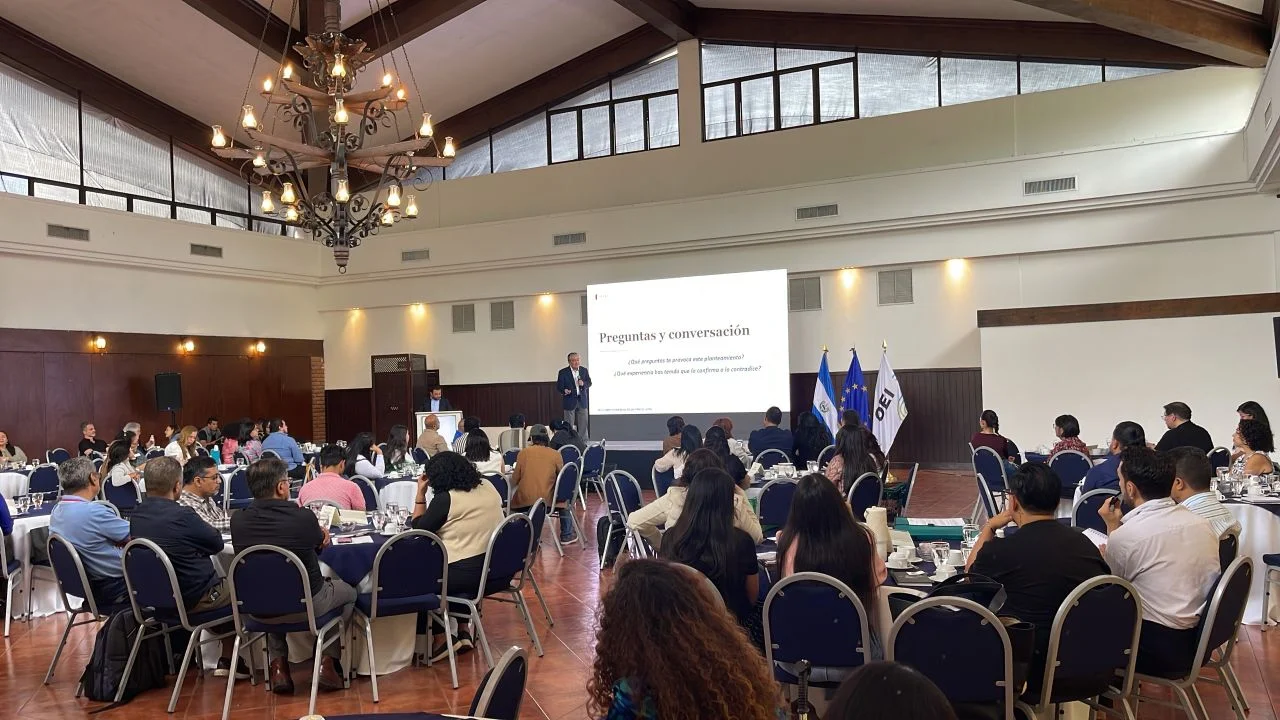
The ICC Forum had a motto that ran through everything: "nobody scales alone". The "I offer" sticker exercise opened the day with each participant declaring a resource available to others. The two ICC LAB sessions put all 150 attendees to work identifying the sector's challenges first, and then 180-day commitments that don't depend on external funding. The spirit of the gathering was the exact opposite of what prevails in most sector events: instead of asking the government or cooperation for more resources, participants assumed that transformation has to come from within.
It wasn't our first time working with this ecosystem in El Salvador. Months earlier, Suricata Labs had trained 105 digital transformation agents to support Salvadoran creative entrepreneurs in AI and digital tools. The Forum closed one cycle and opened another: from individual strengthening to collective movement.
That attitude, combined with C³ and a bit of Lean method, is what makes this sector privileged in the AI era. Technology lowered the cost of producing. Coordination lowers the cost of distributing. And accumulated craft gives them something no algorithm will replace anytime soon: a point of view worth listening to.
The older gentleman's question at the forum deserves a direct answer. No, age is not the problem. The problem is giving up on curiosity and stopping to sharpen judgment. As long as those two remain alive, creativity finds a way to express itself. And as long as all three walk together, AI is not a threat to CCIs: it's the first time in history that the cost of materializing an idea approaches the cost of having it.
The cultural and creative sector doesn't need more plans. It needs to execute the ones it already has — with method, validating with a small audience first — and with the conviction that it already holds the most valuable raw material in today's market.