In Ciudad Juárez, 18 companies built their own fix

In Ciudad Juárez, 18 companies built their own solution with generative AI
Eighteen companies from Ciudad Juárez walked out of our workshop with a working prototype.
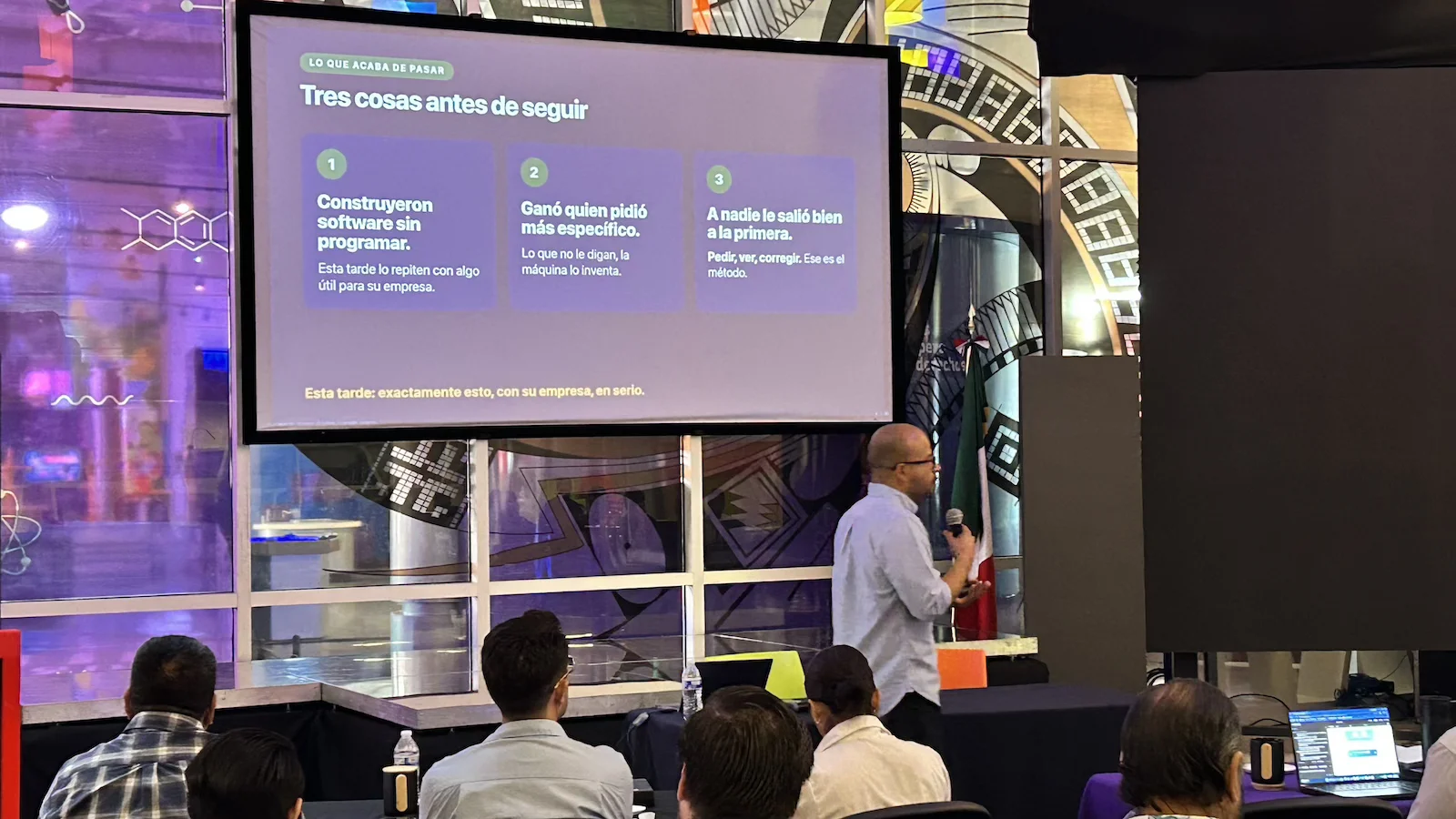
In August we were at the Museo Interactivo La Rodadora, running the applied artificial intelligence component of Innova Lab V3.0. The program is operated by Democratizamos la Innovación to strengthen the digital capabilities of companies in Ciudad Juárez, Mexico, with Fundación Ficosec AC, the state Ministry of Innovation and Economic Development and the city's Economic Development office as partners. Three days, around forty people in the room, representing eighteen companies from sectors that have little in common: cement producers, maquilas, metalworking shops, retailers and a bakery chain. None of them has a technology department. None of them arrived with a software budget.
What we left behind was not a course on artificial intelligence tools. It was a way of working that we have been applying for months and that we call BuildInside.
The workshop does not start with the tool, it starts with a number
Before opening any interface, each company had to complete a sentence with figures: when this happens, today we do that, it takes us this long and it costs us this much. A rough estimate works. A blank does not.
That sentence is what separates an interesting workshop from a useful one. If after three days a company cannot say "quotes used to take us four hours and now they take one", what happened was a nice demo. The baseline number turns the closing session into a comparison you can verify, and it forces people to pick a problem that actually costs money.
Whoever lives the problem is the one who builds the solution
This is the core of BuildInside. The solution does not arrive from a vendor as a black box. It gets built by the people inside the company, the ones who know the routine, the exceptions and what the problem costs to operate, using generative AI as the building tool and with us alongside them.
It sounds obvious. It is not. The dominant model in digital innovation separates the person who suffers the problem from the person who builds the solution, and that imperfect translation is what kills projects. The results were concrete. A metalworking plant built an automatic purchase order analyzer to get the traceability they had been doing by hand until that day. A cement company built an order analyzer that routes each order to the nearest distribution point based on where the customer is. A tire distributor built an inventory analyzer that replaced hours of work in Excel.
Two of the participants told us how it went at the end of the workshop.
What matters is not the first solution, it is the second
Mexico has a wide gap here. According to the Ministry of Economy, only 4.8% of the country's manufacturing companies with ten or more employees use artificial intelligence, and among small companies the figure drops to 1.2%, against an average of 20.2% across OECD countries. The public conversation about AI is moving much faster than actual adoption on the shop floor.
Closing that gap by hiring outside development every time a problem shows up is expensive and slow. Academic work has been studying this for years under the name employee-driven digital innovation. Its known limit was always the same: the employee proposes the idea, but somebody else builds it, and the project gets lost in that handoff. What generative AI changed is that now whoever proposes can build the first version.
We call that configuration GenAI-enabled employee-driven digital innovation. It is not a recognized category in the literature, it is a construct we are putting forward after running it in real programs, and BuildInside is how we bring it into a company. We lay it out in full in what employee-driven digital innovation is, with the six conditions it requires and the known ways it fails. Juárez was one of the exercises that helped us sharpen it the most.
That is the real goal of the method. After the first problem is solved, the company should be able to take on the second one with less help from us, and the third one essentially on its own. The installed capability is worth more than the prototype.
If the companies you work with need to finish with something running rather than with one more diagnostic, let's talk. It is the format we have run in several regions and are now bringing to Mexico.
Read also: What is employee-driven digital innovation?